
5 bcm LNG FSRU Import Terminal
Deep-water, Black Sea gateway for cost-efficient LNG into Ukraine & Europe
PORT PIVDENNYI
5 bcm LNG FSRU Import Terminal is located at the port Pivdennyi, the largest and deepest seaport in Ukraine. It capable receiving cargoes up to ~200,000 DWT and traditionally handles ≈30% of national seaport cargo turnover (35.55 Mt in 2024). Seaport operates 34 berths, with ~4.9–5.0 km of operational cargo quay.
LNG FSRU Import Terminal will use berth #27 of length 350 m and depth of 17 m.

LNG CARRIERS
LNG FSRU TERMINAL
GAS TO POWER
GAS TRADING AND STORAGE
Regas Capacity:
5 bcm/year via FSRU

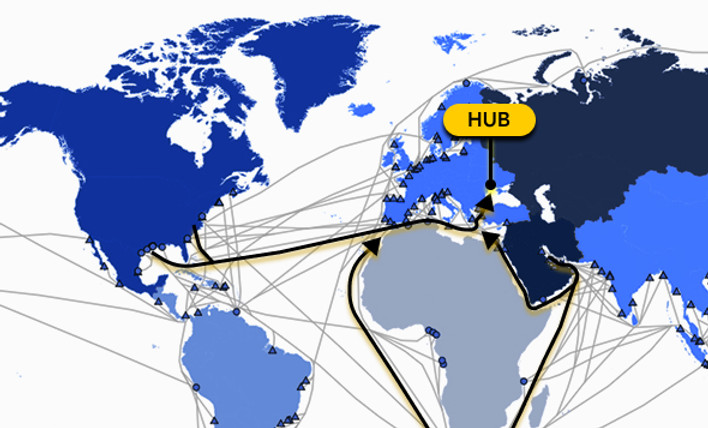
LNG IMPORT ROUTES
5 bcm LNG FSRU Import Terminal connects the Black Sea to the Mediterranean, Suez Canal, and onward to Asia, the Middle East, Africa, and Europe
Competitive advantage
Deep-water port & FSRU flexibility
Can receive large LNG carriers quickly, reducing shipping bottlenecks
Sea route, zero foreign transit tariffs
Avoids multiple tariff zones required for pipeline transit from Baltic terminals
Proximity to demand & transmission grid
Short path to Ukrainian gas grid — faster, cheaper delivery to consumers
Fast to deployment
FSRU capex is faster than onshore terminal capex; quicker build-out to meet urgent demand
Why FSRU vs Onshore
The Case for Flexibility & Speed
01
FSRU-based terminals significantly reduce CAPEX compared to onshore terminals, with modular, standardized design and simpler marine-side infrastructure
02
They allow fast-track deployment ideal for urgent, flexible LNG supply in volatile market conditions
03
Modular scalability: regasification throughput can be scaled up or down according to market demand — useful in both import and re-export / transit scenarios

IMPORTED LNG —> GAS TRANSMISSION SYSTEM
Port Pivdennyi is in the heart of Ukraine’s southern gas transmission corridor, formed by a set of parallel high-pressure trunk lines that run east–west across Odesa oblast, connect to eastern regions in Ukraine, and further southwest to Moldova, Romania, and the Trans-Balkan system.
Via Rozdilna–Izmail line or Ananyiv–Tiraspol–Izmail (ATI) line toward Orlivka interconnection point and into the Trans-Balkan system
Via the Shebelinka–Dnipropetrovsk–Kryvyi Rih–Rozdilna–Izmail line to central and eastern Ukraine, and then further west to Central Europe
South-West
North-west
Gas regasified at Pivdennyi and injected into the Ukrainian GTS near Odesa can move:

European Market Integration
Shortest and most cost-efficient global shipping corridor
Unlike routes to Klaipėda or Świnoujście, which involve additional days navigating into and out of the Baltic and subsequent pipeline transmission south, LNG cargoes to Pivdennyi avoid these detours and proceed directly to the Black Sea coast
It makes Pivdennyi the closest deep-water LNG entry point to the regional demand center of Central and Eastern Europe
Export Capacity
Combined interconnectors provide over 20 bcm/year of technical export capacity from Ukraine into EU markets, through Slovakia, Ukrainian gas can reach the Baumgarten hub in Austria and further into the Czech/Slovak systems, linking Pivdennyi-sourced LNG directly to Central European gas hubs
32 BCM gas storage allows seasonal arbitrage for the EU gas traders
Storage capacities
Ukraine operates 11 underground gas storage (UGS) facilities with a combined active capacity of ~32 bcm and a typical working volume of 25.8–27 bcm — the largest storage system in Europe
Strategic, Reliable, and Secure
Around 80% of Ukraine’s storage capacity is located in the west, several hundred kilometres from the front line. These facilities have remained technically reliable throughout the war. Independent technical assessments for the Energy Community and USAID confirm that Ukrainian UGS and transmission infrastructure can safely and reliably return stored foreign gas even under stress scenarios, despite repeated missile strikes
Cost-Efficient Storage
Under the Customs Warehouse RegimeUkraine’s Customs Warehouse regime allows both resident and non-resident shippers to store gas for up to 1,095 days without customs duties or VAT. When combined with short-haul tariffs and competitive storage fees, total injection and storage costs remain in the low €/MWh range — significantly below most comparable EU facilities.
Growing Use by International Traders
During the 2023 injection season, non-resident traders placed over 2.5 bcm of gas into Ukrainian storage, underscoring strong market confidence in the system.


Market Demand: Ukraine & Europe
Ukraine faces distinct and urgent needs for natural gas, driven by the prequisite for energy system recovery. Since 2022, Ukraine lost ~40% of its nuclear generating capacity (from 13.8 GWt to 8 GWt). In turn, gas-fired plants have become increasingly important for balancing the grid and replacing damaged or destroyed coal infrastructure, much of which was located in the occupied eastern territories. Ukraine started to rely on imported and stored gas to satisfy winter demand
In the future, increasing electricity demand, driven by reconstruction, electrification, and the loss of coal plants, means gas-fired electricity will remain critical for stabilising the grid and powering economic recovery
Demand for LNG in Moldova and other Central European neighbours is growing (est. 5–6 bcm/year regional import potential), but these countries lack regasification infrastructure. This creates an opportunity for an FSRU in Ukraine to function as a strategic regional energy hub, supplying these captive cross-border markets
As a result more than European import terminals where demand for LNG stabilises
Ukraine will be a uniquely reliable long-term offtaker. It positions the FSRU LNG import terminal for decades of strategic use
Tolling Model: Terminal as Service Provider

The Pivdennyi FSRU operates as a regasification service provider rather than a gas buyer or seller. By separating the terminal operator from commercial gas trading, Pivdennyi becomes an open-access infrastructure asset that can serve numerous market participants.
This approach mirrors successful European terminals and aligns with Ukraine's unbundling framework implemented in 2020. It promotes competition in the gas market, promotes supply diversification and maintains compatibility with the EU market norms.
Alignment with 3SI (Three Seas Initiative)
-
The planned expansion of the Poland–Ukraine interconnector, a 3SI priority energy project, explicitly frames Ukraine as a provider of at least 10 bcm of temporary gas storage for Europe. With Pivdennyi in place, LNG can enter directly via the Black Sea, be injected into Ukrainian UGS, and then re-exported through the same PL–UA interconnector.
-
As Pivdennyi FSRU creates a new Black Sea LNG entry point into European grid, it effectively extends the 3SI vectical north–south corridor into a Baltic–Adriatic–Black Sea triangle. It also complements and strengthens security of supply for a Vertical Gas Corridor that currently depends heavily on Greek terminals.
-
As 3SI increasingly incorporates hydrogen into its energy agenda, the infrastructure clustered around the Pivdennyi LNG terminal, including the emerging hydrogen and ammonia hub, ensures the site will remain commercially and strategically useful beyond gas transition. It positions Ukraine as a long-term energy partner for 3SI states.


Status
Engineering documentation for berth construction is ready, itd 17-m-deep approach channel has already been formed
Pivdennyi port operational restrictions and tugs availability appear good for gas carrier operations